
Canada Graduate Research Scholarship 2027 (Fully Funded)
- Canada Graduate Research Scholarship 2027 — Quick Facts Table
- What Is the Canada Graduate Research Scholarship?
- What Does It Cover? (Benefits)
- Who Can Apply? (Eligibility)
- For Master's Applicants (CGRS-M)
- For PhD Applicants (CGRS-D)
- For Both Levels
- What Can You Study?
- How to Apply — Step by Step
- Required Documents
- Application Deadlines
- Tips to Write a Winning Application
- Common Mistakes to Avoid
- ScholarPositions Insight
- Competitiveness Rating: 5/5
- Acceptance Reality
- Best Candidate Profile
- Honest Advice
- Comparison
- Frequently Asked Questions
- Official Source
- Official PhD Application Link
- Official Masters Application Link
Here’s the detail that catches almost everyone off guard: if you’re an international student targeting a Master’s degree in Canada, this scholarship isn’t actually available to you. Not partially. Not with extra hoops. Not at all.
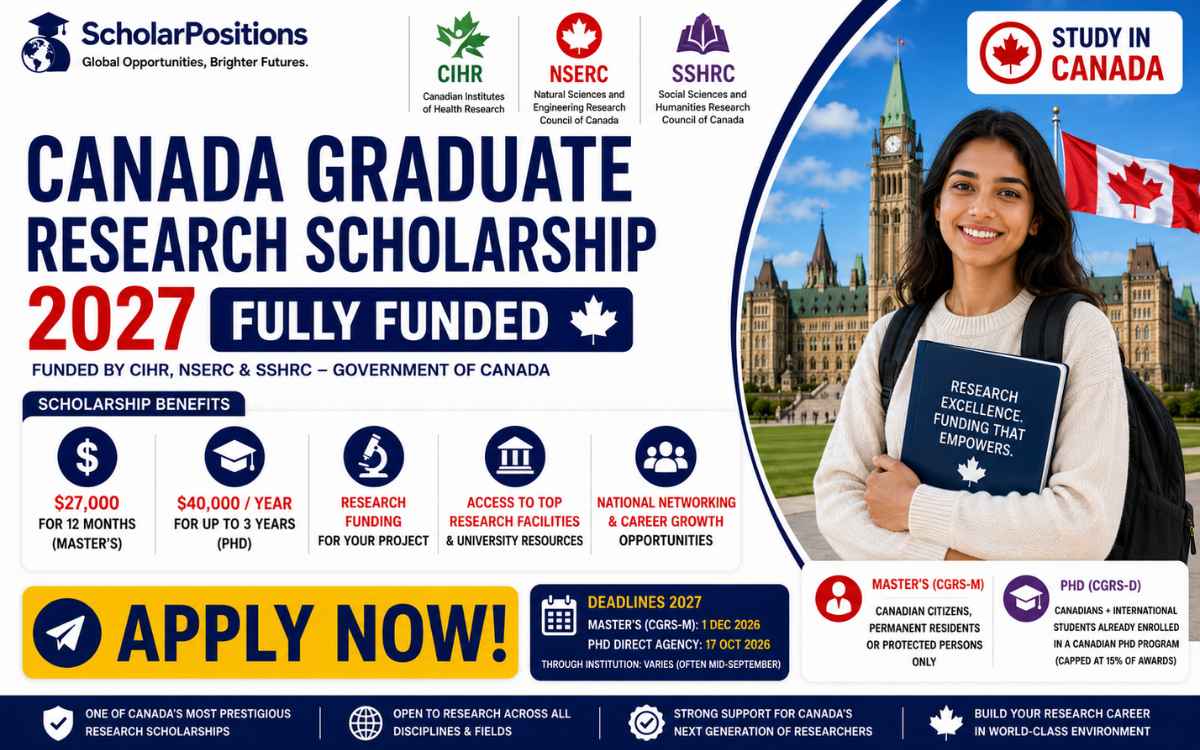
The Canada Graduate Research Scholarship (CGRS) is Canada’s flagship federal research funding program, run jointly by CIHR, NSERC, and SSHRC. The Master’s award (CGRS-M) pays $27,000 for one year, but it’s restricted entirely to Canadian citizens, permanent residents, and protected persons. The Doctoral award (CGRS-D) pays $40,000 per year for up to three years, and international students can apply — but only if they’re already enrolled in a Canadian PhD program, and only up to 15% of awards per agency go to non-Canadians. The Master’s deadline is 1 December 2026; the PhD direct-agency deadline is 17 October 2026.
If you’re serious about Canadian research funding, get this eligibility distinction straight before you spend a single hour on a proposal. It changes your entire strategy depending on which degree level you’re targeting.
Canada Graduate Research Scholarship 2027 — Quick Facts Table
| Category | Details |
|---|---|
| Country | Canada |
| Host Agencies | CIHR, NSERC, SSHRC |
| Degree Level | Master’s and Doctoral (PhD) |
| Who Can Apply (Master’s) | Canadian citizens, permanent residents, or protected persons only — no international eligibility |
| Who Can Apply (PhD) | Canadians (citizens/PRs/protected persons) plus international students already enrolled in a Canadian PhD program (capped at 15% of awards) |
| Financial Coverage | $27,000 for 12 months (Master’s); $40,000/year for up to 3 years (PhD) |
| Master’s Deadline | 1 December 2026 |
| PhD Direct Application Deadline | 17 October 2026 |
| PhD Through-Institution Deadline | Varies by university, often mid-September |
What Is the Canada Graduate Research Scholarship?
The CGRS program is how the Canadian government funds its next generation of researchers, distributed through three federal agencies depending on your field: CIHR for health, NSERC for science and engineering, SSHRC for social sciences and humanities. Despite running through three separate agencies, a CGRS award carries the same weight and recognition no matter which one funds you.
What often gets lost in scholarship summaries is a hard eligibility line that splits the program in two. The Master’s award, CGRS-M, is closed to international students under any circumstance — you need to be a Canadian citizen, permanent resident, or protected person. The Doctoral award, CGRS-D, does open the door to international applicants, but with a real catch: you must already be enrolled in your PhD program at an eligible Canadian institution by the time you apply, not simply admitted or planning to enroll. On top of that, international applicants compete for a capped share, up to 15% of awards per agency, rather than the full pool.
This program also absorbed the former CGS-D and the well-known Vanier Canada Graduate Scholarship under a 2024 restructuring, so if you see either name referenced elsewhere, know that both now route through this same CGRS-D competition.
What Does It Cover? (Benefits)
- CGRS-M: $27,000 for 12 months, a single non-renewable award at the Master’s level
- CGRS-D: $40,000 per year for up to three years (up to $120,000 total), supporting full-time doctoral research
- Research funding for academic projects tied to your proposal
- Access to top Canadian research facilities and university resources
- Academic networking across a well-established national alumni base
- Tuition coverage varies by institution — the federal stipend itself doesn’t include a guaranteed tuition waiver, so check what your specific university layers on top
One sentence summary: The stipends are genuinely strong by international standards, but tuition coverage depends on your university, not the scholarship itself.
Who Can Apply? (Eligibility)
For Master’s Applicants (CGRS-M)
You must be a Canadian citizen, permanent resident, or protected person under Canadian immigration law as of the application deadline. There is no pathway for international students at this level, regardless of academic strength.
For PhD Applicants (CGRS-D)
Canadian citizens, permanent residents, and protected persons can apply whether currently enrolled or still applying for admission. International students can also apply, but only if they are already enrolled in their doctoral program at an eligible Canadian institution by the deadline — holding an admission offer alone isn’t enough. International applicants also compete for a capped 15% of awards per agency.
For Both Levels
- A strong academic record, with a first-class average recommended as a realistic baseline
- A research proposal that clearly aligns with your chosen agency’s mandate
- Only one CGRS application per year, so make your submission count
- For PhD applicants: no more than 36 months of full-time doctoral study completed at the time of application
- For Master’s applicants: no prior CGRS award held previously
One sentence summary: Master’s funding stops at the Canadian border; PhD funding opens it partway, but only for students already studying inside it.
What Can You Study?
Both awards span health sciences, natural sciences, engineering, social sciences, and the humanities. Your agency choice is determined by your research field, not your degree title, so review each agency’s strategic priorities carefully before deciding where to apply — especially if your work sits at the intersection of two fields.
How to Apply — Step by Step
- Confirm your eligibility against the specific level you’re targeting. International applicants should rule out CGRS-M entirely and focus on whether they meet CGRS-D’s enrollment requirement.
- Choose the right agency for your field. Health research goes to CIHR, natural sciences and engineering to NSERC, social sciences and humanities to SSHRC. Getting this wrong can sink an otherwise strong application.
- Review your chosen agency’s specific eligibility requirements. Don’t assume all three agencies apply identical rules — differences exist.
- Prepare your application thoroughly. Write your research proposal, gather every required document, and have it all reviewed before you touch the submission portal.
- Submit through your agency’s official online system, not a general university portal, unless your institution handles submission on your behalf through its own allocation.
- Coordinate with your referees early. Give them real notice, explain what the scholarship evaluates, and confirm they can submit before your specific deadline.
- Track both your institutional deadline and the national deadline. Where your university holds a quota, its internal cutoff often falls weeks before the agency’s own date.
One sentence summary: Confirm which level you actually qualify for first, then treat agency selection and proposal quality as the two decisions that matter most.
Required Documents
- Completed online application form — through your chosen agency’s portal
- Academic transcripts — covering your complete academic history, not just your current program
- Research proposal — the single most heavily weighted document in your application
- Curriculum Vitae — ideally in the Canadian Common CV format most agencies require
- Letters of recommendation — chosen from referees who know your research directly, not just your coursework
- Proof of English language proficiency — required by most Canadian institutions for international applicants
- Additional documents your specific agency requests — confirm these on the agency’s own program page
Application Deadlines
| Level | Deadline |
|---|---|
| CGRS-M (Master’s) | 1 December 2026 |
| CGRS-D (PhD, direct to agency) | 17 October 2026 |
| CGRS-D (PhD, through institution) | Varies — often mid-September |
The PhD direct-application deadline lands earlier than most applicants expect. If you’re targeting CGRS-D, treat mid-October as your real anchor point, which means starting your proposal well before summer ends.
Tips to Write a Winning Application
- Write a research proposal with real specificity. A vague interest area like “I want to study public health policy” tells a reviewer almost nothing — name your actual research question, your methodology, and why it matters now.
- Match your proposal language to your chosen agency’s stated priorities. Research that sits at the border between two agencies needs to be framed deliberately for whichever one you pick.
- Build in multiple rounds of revision. The strongest CGRS applications get reviewed and rewritten several times with input from supervisors or mentors, not finalized in the last two weeks.
- If you’re an international PhD applicant, address your enrollment status directly. Reviewers need to see clearly that you meet the stricter international eligibility bar, not assume it.
- Choose referees who can speak to your actual research work, not just seniority or name recognition.
- Track your institution’s internal deadline the moment you decide to apply. These frequently land well before the national cutoff.
- Don’t submit a proposal you haven’t had anyone else review. Outside feedback catches unclear framing you can’t see in your own writing.
Common Mistakes to Avoid
- International applicants assuming CGRS-M is open to them. It categorically isn’t — confirm this before investing preparation time.
- International PhD applicants applying while only holding an admission offer. You must already be enrolled, not simply accepted, at the time of application.
- Choosing the wrong agency for your research field. Even an excellent proposal submitted to the wrong agency is a mistake you can’t recover from within that cycle.
- Missing an earlier institutional deadline while only tracking the national one. This can eliminate you before the national competition even sees your file.
- Submitting a generic, broadly worded research proposal. Vagueness is one of the most consistent reasons strong-on-paper candidates don’t advance.
ScholarPositions Insight
Competitiveness Rating: 5/5
Both levels draw from strong applicant pools, and CGRS-D’s international quota — capped at 15% of awards per agency — makes the doctoral route especially tight for non-Canadian applicants specifically, on top of already being a nationally competitive program.
Acceptance Reality
Neither program publishes a single consolidated acceptance rate, but CGRS-M distributes a fixed number of awards through individual university allocations, meaning your odds depend heavily on how large your specific institution’s allocation is that year. For CGRS-D, the 15% international cap means non-Canadian applicants compete for a meaningfully smaller slice of a program that’s already selective for domestic candidates.
Best Candidate Profile
Winning applicants typically arrive with a research proposal that reads as already partially developed — not a fresh idea sketched out for the application, but something they’ve discussed with a supervisor, refined across multiple drafts, and can defend with real specificity. International PhD applicants who succeed are almost always well into their first year of study already, with an active supervisor backing their proposal and enrollment status clearly documented.
Honest Advice
If you’re an international student building a funding plan around a Canadian master’s degree, do not count on CGRS-M — it’s simply off the table for you, and discovering that late costs real time you can’t get back. Put your energy into securing a strong PhD placement instead, since that’s your only route into this specific funding stream as a non-Canadian. And for every applicant, Canadian or international: the research proposal carries enormous weight in this competition. A polished CV attached to a vague proposal consistently loses to a sharp, well-defined proposal from a less decorated candidate.
Comparison
Compare this to the Fulbright Foreign Student Program in the United States, which is open to international applicants at both the Master’s and Doctoral level with no citizenship restriction comparable to CGRS-M’s. Fulbright leans more toward cultural exchange and leadership potential alongside academic merit, while CGRS-D is narrowly focused on research potential and offers a larger total dollar amount over three years specifically for doctoral study. If you’re Canadian, CGRS gives you access to funding at both degree levels; if you’re international, CGRS-D’s enrollment requirement makes it a later-stage option compared to Fulbright’s broader entry point.
Frequently Asked Questions
1. Is the Canada Graduate Research Scholarship 2027 fully funded? Yes, in terms of stipend and research support — $27,000 for Master’s, $40,000 per year for up to three years for PhD. Tuition coverage beyond the stipend depends on your specific institution.
2. Can international students apply? For CGRS-M, no — this level is restricted to Canadian citizens, permanent residents, and protected persons. For CGRS-D, yes, but only if you’re already enrolled in a Canadian PhD program, and only up to 15% of awards per agency go to international applicants.
3. Do I need IELTS or English proof? Most Canadian universities require proof of English proficiency for international applicants. This comes from the institution, not the CGRS program itself, so check your specific university’s requirements.
4. Can I apply without admission? Canadian CGRS-M and CGRS-D applicants can apply while admission is still pending. International CGRS-D applicants cannot — you must already be enrolled at the time of application.
5. How competitive is this scholarship? Very. A strong academic record and a genuinely specific, well-developed research proposal are the baseline for a credible application, and the international PhD cap makes that route especially tight for non-Canadians.
6. Can I apply to more than one agency in the same year? No. Only one CGRS application is permitted per year, so choose your agency carefully based on where your research genuinely fits.
7. What happens if I miss my university’s internal deadline? You’re generally eliminated from that year’s national competition, even if the agency’s own deadline hasn’t passed, since many applications route through an institutional review first.
8. What if I’m not selected? Canadian applicants can typically reapply in a future cycle if they remain eligible. International PhD applicants can also reapply, though CGRS-D applications are capped at a limited number of attempts per agency.
Official Source
For the most accurate and current details, always check the CGRS-M and CGRS-D pages directly on CIHR, NSERC, or SSHRC’s official websites, and confirm your specific university’s internal deadline before beginning your application.
Official PhD Application Link
Official Masters Application Link

Written by
Ayan Adeel
Ayan Adeel is an educational content researcher and scholarship editor with several years of experience tracking and verifying fully funded opportunities from governments, universities, and international organizations worldwide. He founded ScholarPositions after witnessing firsthand how thousands of legitimate scholarships go unclaimed every year simply because deserving students never heard about them. Since launching the platform…
Explore Opportunities by Interest
Discover scholarships, internships, and fellowships in your favorite fields.
Similar Scholarships You May Like
Based on your interest in this category.
Carleton University Prestige Scholarships 2027 (Up to $32K)
📅 Aug 02, 2026Canada Graduate Research Scholarship 2027 (Fully Funded)
📅 Apr 06, 2026Lester B. Pearson International Scholarship 2027
📅 Aug 02, 2026Concordia University Scholarships 2026–2027
📅 Jun 24, 2026UBC Public Scholars Award 2026-27 (Innovative Doctoral Research Support)
📅 May 14, 2026University of Guelph National Humanities Fellowship 2027-28
📅 Mar 19, 2026Canadian International Development Scholarships 2030
📅 Sep 28, 2026Pierre Elliott Trudeau Foundation Doctoral Scholarships 2027 (Fully Funded)
📅 Apr 06, 2026Fresh Opportunities
Latest scholarships added recently.
 New
Stockholm University Scholarship 2027 | Full Tuition
 New
Hurford Youth Fellows Program 2027 | NED Fellowship
 New
FRIAS Fellowship 2028 | Study in Germany
 New
Chinese Language Teachers Scholarship 2027 | CNY 2,500/Month
 New
NINE DTP ESRC Scholarship 2027 | Full Funded
 New
Weathering Life PhD 2027 | Max Planck Institute
 New
Liverpool PhD Scholarship 2027 | Fully Funded
 New
East Africa Biodesign Fellowship 2027 | Full Funded
 New
UIN Malang Scholarship 2027 | Partial Funding
 New