East African Community Scholarships 2026-27 (Fully Funded)
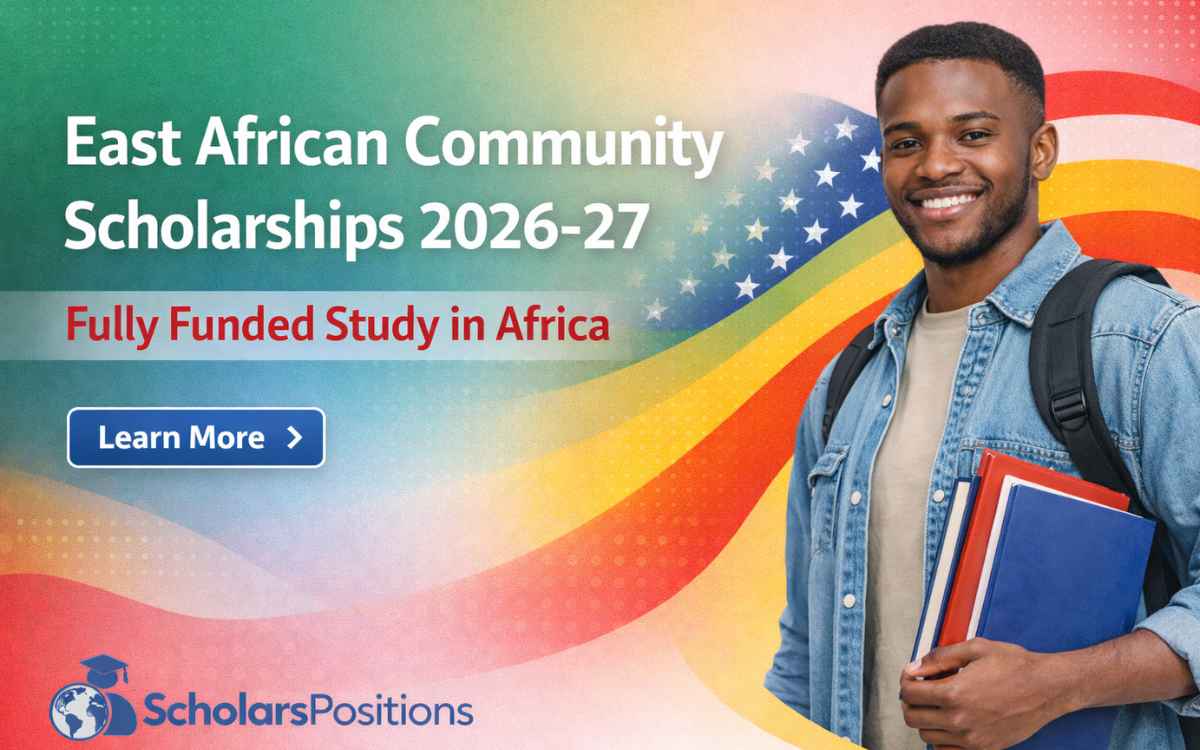
What if studying in a neighbouring East African country — fully funded — could accelerate your career, broaden your worldview, and make you part of something bigger than just a degree? That’s exactly what the East African Community Scholarships 2026-27 are designed to do.
This isn’t your typical scholarship. Backed by the Federal Republic of Germany through the KfW Development Bank and administered by the Inter-University Council for East Africa (IUCEA), this program is built around a genuinely powerful idea — that East Africa’s brightest minds should be solving East Africa’s biggest challenges. It does that by funding talented students from across the region to study in EAC partner states other than their own, creating cross-border connections between Kenya, Uganda, Tanzania, Rwanda, Burundi, and South Sudan.
So if you’re an ambitious graduate from any of those countries, with strong academics and a clear sense of where you want to take your career — this scholarship deserves your full attention.
Scholarship Overview
| Category | Details |
|---|---|
| Host Country | Kenya, Burundi, Rwanda, South Sudan, Tanzania, Uganda |
| University / Organization | Inter-University Council for East Africa (IUCEA) / KfW |
| Degree Level | Master’s Degree (Primary focus) |
| Funding Type | Fully Funded |
| Duration | 2 Years |
| Intake | 2026-2027 Academic Year |
Financial Coverage
Let’s talk about what “fully funded” actually means here — because this package is comprehensive in all the right ways.
- Full tuition fees — every academic expense charged by your host university is paid directly. You won’t see a tuition bill
- Monthly stipend of EUR 380 — a living allowance to cover housing, utilities, food, and local transport throughout your studies
- Return flight ticket — one round-trip economy class flight from your home country to your host country, covered
- Research and Study Grant of EUR 1,500 — a one-time payment specifically for study materials and research-related costs. That’s a meaningful amount for books, software, and field work
- Medical insurance — comprehensive health coverage for the full duration of your program
Put it all together and this is a genuinely well-structured package. You can focus entirely on your studies and research without the constant background noise of financial stress — which is exactly how a scholarship should work.
Eligibility Criteria
Before you start preparing documents, make sure you actually qualify. Here’s what the program requires:
- Citizenship — you must be a legal citizen of one of the six EAC partner states: Burundi, Kenya, Rwanda, South Sudan, Tanzania, or Uganda
- Age limit — you must be under 35 years old at the time of application
- Academic record — you need a “Distinction” or Upper Second-Class Honours in your previous degree, or an equivalent qualification
- Mobility requirement — this one is non-negotiable and central to the whole program. You must apply to a university in an EAC country other than your own. If you’re Kenyan, you’re applying to Uganda, Tanzania, or elsewhere in the region — not Nairobi
- English proficiency — a high level of English is required, as your motivation letter and all coursework will be in English
That mobility requirement is the one most people stumble on — so let it sink in before you start shortlisting universities.
Required Documents
Get certified, high-quality scans of everything ready before you even open the application form:
- Certified copies of your undergraduate degree and transcripts
- A signed, professional CV — Europass format is often preferred
- A copy of your university admission letter or proof of application
- Valid National Identity Card, Passport, or Birth Certificate
- A recent passport-sized photograph
- A well-drafted Motivation Letter in English — this one matters more than almost anything else
- Medical reports and academic reference letters
“Certified” is the key word throughout that list. Don’t submit informal copies or unverified scans. Get them properly certified by the relevant authorities — and start that process early, because it takes longer than expected.
Application Process
Here’s where things get a little more involved than a standard scholarship — this one runs on a dual-track process, and you need to move on both tracks simultaneously.
- University Admission first — choose a program and a host university from the approved EAC list. Makerere University in Uganda and the University of Nairobi in Kenya are among the participating institutions. Apply directly through that university’s portal and pay any application fees required
- Scholarship Application — once you’ve initiated the university process, visit the IUCEA website and download the official scholarship application form
- Compile everything — put all your documents together into a single PDF zip folder
- Email submission — send your complete file to both designated addresses:
- Subject line — follow this exactly — use the format: [Your Name], [Program Name], [Target University]. Don’t improvise on this. Applications with incorrect subject lines can be overlooked or filed incorrectly
That subject line requirement sounds minor, but strict formatting compliance is often the first filter in a competitive process. Get it right from the start.
Application Deadline
June 30, 2026 is the anticipated closing date for the 2026-27 cycle.
But here’s the practical reality — since university admission deadlines vary across the region, you should ideally start your university application process at least three months before the scholarship deadline. That means moving on this now, not in April or May.
Always verify exact dates directly on the official IUCEA portal, as these can shift depending on the cycle and participating institutions.
Official Website
For the most accurate and current information — participating universities, specific course codes, downloadable forms, and submission details — go straight to the Inter-University Council for East Africa (IUCEA) official portal. That’s your definitive source for everything related to this scholarship.
Official Application Link
What Makes This Scholarship Unique
Most international scholarships send African students to Europe or North America. This one does something different — and arguably more powerful.
The East African Community Scholarships are built around the concept of Regional Brain Circulation. The idea is straightforward but important: East African problems are best solved by East Africans, equipped with knowledge gained from within the region itself. By studying in a neighbouring EAC country, you’re not just getting a degree — you’re building cross-border networks, understanding regional dynamics from the inside, and becoming part of a generation of professionals who are genuinely connected across national boundaries.
The German KfW Bank’s involvement adds both financial stability and international credibility to the program. This isn’t a small-scale local initiative — it’s a regionally significant, internationally backed investment in East Africa’s future. And you could be part of it.
Who Should Apply / Who Should Not Apply
Who Should Apply: Students who are passionate about regional development — not just their own career, but the broader growth of East Africa as a unified community. If you have a strong academic record, genuine curiosity about a neighbouring culture, and a field of study that connects to regional challenges, this scholarship was designed with you in mind.
Who Should Not Apply: If you want to study in your home country, this program isn’t for you — the mobility requirement is the whole point. If you’re over 35, you won’t qualify. And if your degree classification falls below Upper Second-Class Honours, the academic bar won’t be met. Be honest with yourself about these things before investing time in the application.
FAQ Section
1. Can I apply if I haven’t received my final transcript yet? Generally, no. You need certified degree documents and transcripts at the time of application to demonstrate you meet the Upper Second-Class Honours requirement. Don’t wait on results — if you don’t have them yet, plan your timeline accordingly.
2. Are the scholarships available for PhD students? The 2026-27 cycle focuses primarily on Master’s degree programs. There are 75 slots available for this intake, so competition is real. Check the IUCEA portal for any updates on PhD availability in future cycles.
3. Is there a bond to return home after studies? There’s no formal bond or legal requirement to return. But the program’s entire purpose is to develop leaders for the EAC region — so the expectation, culturally and professionally, is that you’ll bring your skills back and contribute to the region’s growth.
ScholarPositions Insight
The most common reason applications fail here isn’t weak academics — it’s a misunderstanding of the mobility rule. Ugandan students applying to Ugandan universities. Kenyan students applying to Kenyan institutions. It happens more than you’d think, and it results in instant disqualification. Read the requirement, understand it, and plan your university choice around it from day one.
The other thing that separates successful applicants from unsuccessful ones — the motivation letter. This is not the place to talk about how much you need financial support. The selection committee already knows you need funding — that’s why you’re applying. What they want to know is how your specific field of expertise connects to East Africa’s development goals. Are you studying geothermal energy? Talk about the region’s renewable energy potential. Taxation or public finance? Connect it to regional economic integration. Environmental science? Frame it around shared EAC ecological challenges.
Be specific. Be regional. Be forward-looking. That’s what a strong motivation letter looks like for this particular scholarship.
Final Advice
The East African Community Scholarships are one of the most meaningful funded opportunities available for graduate students across the region — not just because of the financial package, but because of what the program represents and what it can do for your career trajectory.
But it rewards preparation. Start identifying your target university now. Get your documents certified early. Write a motivation letter that actually says something. Follow the submission instructions to the letter — including that subject line format.
June 30, 2026 is your deadline. But your real deadline is right now — the moment you decide to take this seriously and start moving.
East Africa needs its next generation of leaders. This scholarship is one of the clearest pathways to becoming one.
This article is prepared by the ScholarPositions editorial team, focusing on verified and up-to-date international scholarship information.

Written by
ayan
Ayan Adeel is the founder and chief editor of ScholarPositions. He built this platform after observing firsthand how thousands of fully funded scholarships go unfilled every year — not because…
View all articles →