MEXT Japan Government Scholarship 2027 (Fully Funded)
Let’s talk about one of the most respected scholarships in the world — the MEXT Japan Government Scholarship 2027. If studying in Japan has ever crossed your mind, this is the one you’ve been waiting for.
For decades, Japan’s Ministry of Education, Culture, Sports, Science and Technology — MEXT for short — has been inviting some of the world’s brightest students to study in Japan, completely funded. We’re talking undergraduate, Master’s, and PhD programs, all covered. Whether you want to study engineering, dive deep into Japanese history, or research robotics at a world-class lab, this scholarship removes the one thing that stops most people — money.
But here’s what makes MEXT different from most scholarships. It’s not just about your grades. It’s about whether you genuinely want to build a bridge between your country and Japan. The Japanese government isn’t just investing in your education — they’re investing in a long-term relationship. Keep that in mind as you read through this.
Quick Summary of MEXT Japan Government Scholarship
| Award | Fully Funded |
| Country | Japan |
| Degree Level | Undergraduate, Masters, PhD |
| Deadline | Varies by Embassy (Usually May–August 2026) |
Scholarship Overview
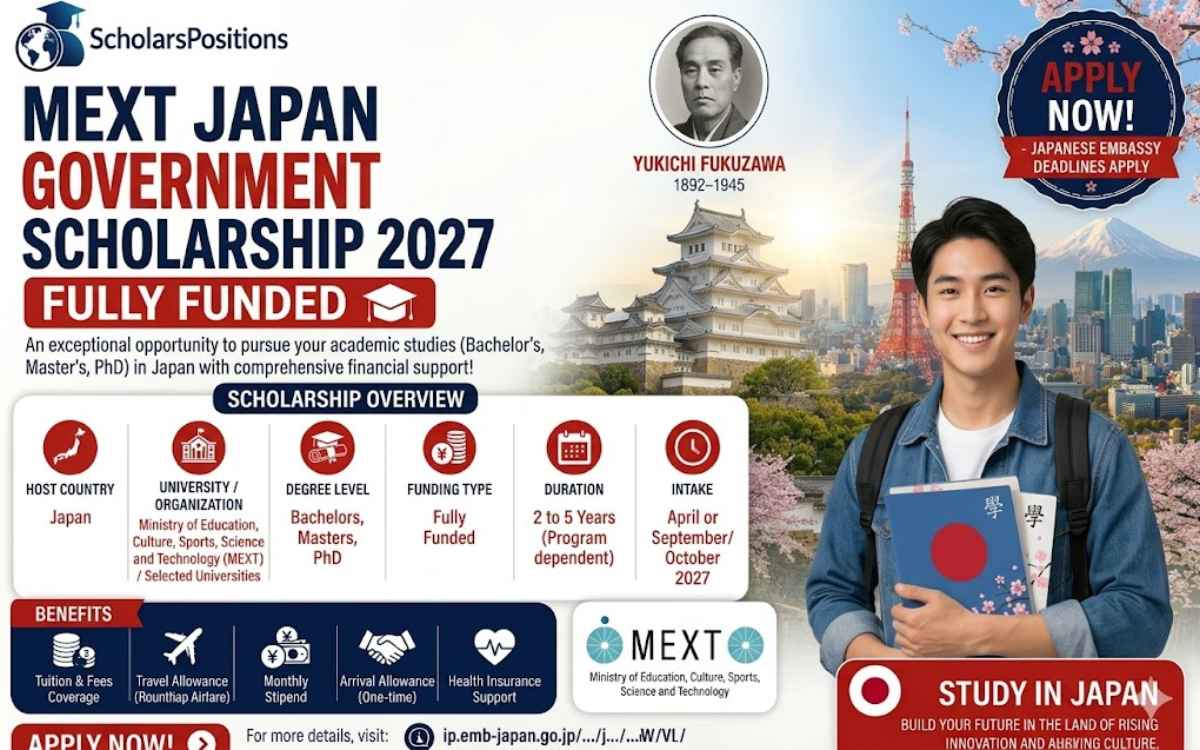
| Category | Details |
|---|---|
| Host Country | Japan |
| University / Organization | Ministry of Education (MEXT) / Selected Universities |
| Degree Level | Bachelors, Masters, PhD |
| Funding Type | Fully Funded |
| Duration | 2 to 5 Years (Program dependent) |
| Intake | April or September/October 2027 |
Financial Coverage
One of the best things about MEXT is that the financial package is genuinely comprehensive. You won’t need to pick up a part-time job to get by — the scholarship is designed so you can focus entirely on your studies and research.
Here’s what’s on the table:
- Tuition fees — fully covered, including entrance examination and matriculation fees at national universities
- Monthly stipend — and it’s not a token amount either:
- Undergraduate students: ~¥117,000/month
- Master’s students: ~¥144,000/month
- PhD students: ~¥145,000/month
- Return airfare — economy class, from your home country to Japan at the start, and back at the end
- Japanese language training — if you need it, there’s a funded 6-month intensive language course before your main program begins
That language course alone is incredibly valuable. Most scholarships just throw you into the deep end. MEXT actually prepares you for life in Japan before your degree even starts.
Eligibility Criteria
Before you get too deep into planning, let’s make sure you’re actually eligible. Here’s what MEXT requires:
- Nationality — you must be from a country that has diplomatic relations with Japan
- Age limits:
- Undergraduate applicants: generally born on or after April 2, 2000
- Graduate applicants (Master’s/PhD): born on or after April 2, 1992 (under 35)
- Academic background — 12 years of schooling for undergraduate, 16 years for graduate programs
- Health — you must be physically and mentally fit to study in Japan
- Language — some programs are in English, but a genuine willingness to learn Japanese goes a long way. Strong TOEFL, IELTS, or JLPT scores are a definite plus
Nothing too surprising here, but pay close attention to the age limits — they catch a lot of people off guard.
Required Documents
This is where MEXT gets serious. The documentation requirements are detailed, and many documents need to be officially translated into English or Japanese. Start early — seriously.
Here’s what you’ll typically need:
- MEXT Application Form (official 2027 version — don’t use an old one)
- Direct Placement Preference Form (undergraduate applicants)
- Academic transcripts from every institution you’ve attended
- Graduation certificates or an “Expected Graduation” letter
- Recommendation letters (academic or professional)
- Medical certificate in MEXT’s specific format
- Research Proposal/Study Plan — especially critical for Master’s and PhD applicants
- Abstract of previous theses, if applicable
- Language proficiency certificate
That research proposal deserves its own conversation — we’ll get to that in a bit.
Application Process
MEXT typically follows what’s called the Embassy Recommendation track. It’s competitive and has multiple stages, so understanding the full journey upfront helps a lot.
Here’s how it works:
- Embassy Inquiry — Start by contacting the Japanese Embassy or Consulate in your country to get the local requirements and exact deadlines. Every country is slightly different.
- Initial Submission — Submit your full document package to the Embassy.
- First Screening — This includes a document review, written examinations in English and Japanese, and an interview for candidates who make the cut.
- University Placement — If you pass, graduate students need to reach out to Japanese universities directly and secure a “Letter of Provisional Acceptance.”
- Second Screening — MEXT headquarters in Tokyo does the final review based on embassy recommendations and university placements.
- Final Notification — Successful candidates get their placement details and visa instructions.
Yes, it’s a multi-stage process. But each stage is an opportunity to show you’re serious — and that matters to MEXT.
Application Deadline
Here’s the thing about MEXT deadlines — there isn’t one universal date. The process is decentralized, meaning each Japanese Embassy sets its own local deadline.
Most embassies open their application windows somewhere between April and August 2026 for the 2027 intake. Some open earlier, some later.
Your best move right now? Go to the Japanese Embassy website for your specific country and look for the “Study in Japan” section. Bookmark it. Check it regularly. Missing the window because you weren’t paying attention would be a painful way to lose a year.
Official Website
For the most accurate and up-to-date guidelines, downloadable forms, and official announcements, visit the Japanese Embassy website in your country or the official MEXT website. Don’t rely on unofficial summaries for final decisions — always verify directly from the source.
Official Application Link
What Makes This Scholarship Unique
Plenty of scholarships offer funding. MEXT offers something bigger.
When you become a MEXT scholar, you join a global alumni network of researchers, academics, policymakers, and industry leaders who have all walked the same path. That network is real and it opens doors — in Japan and internationally.
The language and cultural immersion period built into the program is something most scholarships don’t bother with. MEXT actually invests in making sure you can function and thrive in Japanese society — not just survive it.
And practically speaking, being a MEXT scholar gives you a significant edge when it comes to internships and job opportunities in Japan’s tech, manufacturing, and research sectors. Companies there know what the scholarship represents.
Who Should Apply / Who Should Not Apply
Who Should Apply:
- Students who genuinely love Japanese culture and want to contribute to global research — not just those chasing a prestigious name
- High-achieving students who lack the financial means to study abroad independently
- Anyone targeting careers in fields where Japan is a world leader — robotics, disaster management, materials science, animation, and more
Who Should Not Apply:
- Anyone holding Japanese nationality
- Military personnel or those with active military affiliations
- Students already enrolled in a Japanese university under a different visa
- Anyone who can’t commit to a program that may last up to five years — this isn’t something you can quit halfway through easily
FAQ Section
1. Is Japanese language proficiency mandatory? Not necessarily — at least not at the application stage. Most graduate research programs can be conducted in English if your research allows it. That said, undergraduate applicants usually have to sit a Japanese language exam, and all scholars are strongly encouraged to learn the language throughout their time in Japan.
2. Can I apply while still in my final year of school? Yes, absolutely. You just need to provide a certificate of expected graduation, confirming you’ll complete your degree before the scholarship begins.
3. Does MEXT cover family members? No — the scholarship covers you and only you. You can bring family on a dependent visa, but you’d need to show you have enough personal funds to support them. The MEXT stipend alone won’t be accepted as proof of that.
ScholarPositions Insight
The most common mistake? A generic research proposal.
Japanese professors — and the MEXT selection committee — can spot a copy-paste proposal from a mile away. Writing that Japan is “technologically advanced” as your reason for applying isn’t going to cut it. You need to identify a specific professor, at a specific university, whose specific research aligns with what you want to do. That level of detail signals that you’ve done your homework and you’re serious.
A few tips that actually make a difference:
- For the interview — Be ready to talk about how you’ll handle cultural adjustment and how you plan to take what you learn back to your home country. MEXT wants scholars who will create lasting connections, not just collect a degree.
- Learn some Japanese before you apply — Even a JLPT N5 or N4 certificate shows intentionality. It tells the committee you’re already investing in this before you even get accepted. That stands out.
Real talk on timing: Getting your transcripts officially attested, finding the right professor, securing strong recommendation letters — all of this takes way longer than people expect. Start at least 3 to 4 months before your embassy’s deadline. Treat the research proposal as the heart of your entire application, because it genuinely is.
Final Advice
The MEXT Japan Government Scholarship 2027 is not a quick application you knock out over a weekend. It’s a long, multi-stage process that demands real preparation, genuine motivation, and meticulous attention to detail.
But here’s the flip side — the reward is extraordinary. A world-class education in one of the most innovative, stable, and culturally rich countries on the planet. A global alumni network. A career edge that follows you for life.
If you meet the requirements and Japan genuinely excites you academically, don’t overthink it. Start your documents now, find your target professor, write a proposal that actually means something, and keep a close eye on your embassy’s announcements.
The process is long — but so is the career you’re building. Make it count. 🎌
This article is prepared by the ScholarPositions editorial team, focusing on verified and up-to-date international scholarship information.